
What Types of Fall Protection Systems Does OSHA Accept for Construction Sites?
Working at elevation on a commercial building near Downtown Charleston or scaling a structure along the Kanawha River carries inherent physical risks. A single misstep on an unprotected edge can alter a worker’s life permanently. The construction industry consistently records falls as the leading cause of occupational fatalities and severe injuries, making rigorous safety standards not just a regulatory formality, but a literal lifeline for tradespeople.
At What Height Does OSHA Require Fall Protection on a Construction Site?
Under OSHA standards, construction employers must provide fall protection when employees work at a height of six feet or more above a lower level. This mandatory requirement applies to walking and working surfaces, open-sided floors, edges, and residential construction projects.
The six-foot rule is the foundational trigger for fall protection in the construction industry, outlined in 29 CFR 1926 Subpart M. Unlike general industry standards, which trigger at four feet, construction environments have unique operational demands. However, the requirement is absolute once a worker’s boots leave that six-foot threshold. We frequently observe safety protocols being bypassed on fast-paced jobsites along Interstate 79 or in the Marcellus Shale region to speed up project timelines. This prioritization of speed over safety directly violates federal law and creates an immediate threat to the workforce.
The regulations do not allow employers to rely solely on worker experience or verbal warnings. When a physical fall hazard exists, a physical intervention must be installed. Specific areas on a construction site that mandate immediate fall protection include:
- Unprotected sides and leading edges of floors and roofs.
- Hoist areas where materials are actively loaded and unloaded.
- Holes in walking surfaces, including elevator shafts and skylights.
- Formwork and reinforcing steel installations.
- Excavation sites with unprotected edges.
What Are the Primary Fall Protection Systems Accepted by OSHA?
OSHA primarily accepts three conventional fall protection systems for construction sites: personal fall arrest systems, guardrail systems, and safety net systems. Employers must implement at least one of these physical safeguards before allowing workers to operate at elevated heights.
The fundamental principle behind federal safety regulations is that hazards must be engineered out of the environment whenever possible. General contractors operating in venues from Parkersburg to Wheeling are responsible for assessing the specific demands of each construction phase and selecting the appropriate system. Often, the choice depends on the structural realities of the building and the mobility required by the tradespeople.
When an employer fails to provide one of these three recognized systems, they are placing their staff in immediate jeopardy. The consequences of these failures frequently lead to emergency transport to facilities like Charleston Area Medical Center (CAMC) or Mon Health, dealing with severe orthopedic fractures, spinal cord damage, and traumatic brain injuries.
The accepted systems function differently but serve the same ultimate protective goal:
- Guardrail Systems: Act as a passive barrier preventing the fall from initiating.
- Personal Fall Arrest Systems (PFAS): Act as an active restraint, stopping a worker safely mid-air after a fall has occurred.
- Safety Net Systems: Serve as a passive catch mechanism below the work area.
The Anatomy and Requirements of a Personal Fall Arrest System
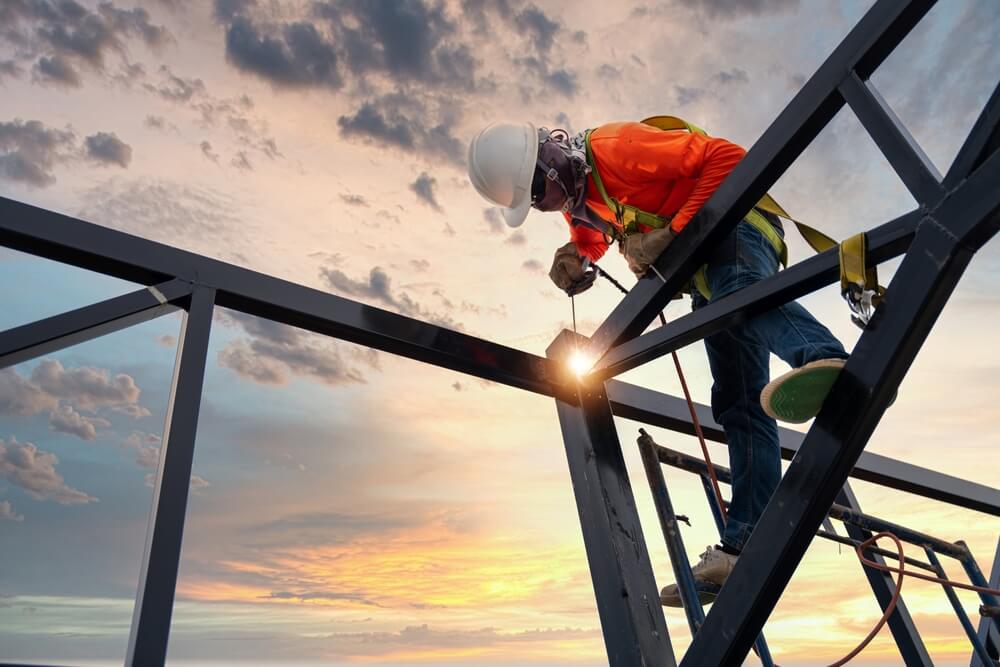
A Personal Fall Arrest System is the most common active protection method used on complex job sites. It is highly effective but requires rigorous training and strict adherence to equipment limitations. A legally compliant PFAS consists of three interdependent components: the anchorage point, the body harness, and the connecting device (usually a shock-absorbing lanyard or a self-retracting lifeline). If any single component fails, the entire system is useless.
The anchorage point is often the most misunderstood element on a job site. Tying off to a weak structural component, a plumbing pipe, or a loose beam provides a false sense of security, which is often deadlier than having no protection at all. OSHA requires that anchor points used for fall arrest must be capable of supporting at least 5,000 pounds per employee attached, or be designed, installed, and used under the supervision of a qualified person as part of a complete system that maintains a safety factor of at least two.
Furthermore, the body harness must distribute the arresting forces over the thighs, pelvis, waist, chest, and shoulders. The older style of body belts is strictly prohibited for fall arrest because the force of a sudden stop concentrates on the abdomen, causing severe internal injuries. Finally, the connecting device must be measured and rigged so an employee can neither free fall more than six feet nor contact any lower level before the fall is completely arrested.
How Do Guardrail Systems Comply With Federal Safety Standards?
A legally sufficient guardrail system must include a top rail positioned 39-45 inches above the walking surface, a midrail, and a toeboard. The structure must be capable of withstanding at least 200 pounds of downward or outward applied force.
Guardrails are considered a passive fall protection system because, once installed properly, they require no action from the worker to remain safe. You will see these utilized extensively on multi-story commercial builds in the Kanawha Valley. However, simply stringing up flimsy caution tape or thin wire does not fulfill an employer’s legal obligation to protect their staff.
OSHA outlines strict criteria for the materials and construction of these barriers. Wire rope, steel tubing, and construction-grade wood are acceptable, provided they meet the weight-bearing requirements. The midrail must be installed approximately halfway between the top edge of the guardrail and the working surface to prevent a worker from sliding underneath. Additionally, the system must be surfaced smoothly to prevent puncture wounds, lacerations, or snagged clothing that could cause a worker to lose their balance.
When Can Employers Use Safety Net Systems for Fall Protection?
Employers can utilize safety net systems when workers operate more than 25 feet above the ground or water. These nets must be installed as close as practicable under the working surface but never lower than 30 feet below.
Safety nets are frequently deployed during bridge construction over the Kanawha River or during large-scale steel erection projects where guardrails and harnesses are temporarily infeasible. Because nets catch falling workers, they must undergo rigorous testing. OSHA requires that safety nets be drop-tested at the job site after initial installation, whenever relocated, after major repairs, and at six-month intervals if left in one place.
A significant hazard associated with safety net systems is the accumulation of debris. If a worker falls into a net filled with dropped tools, scrap metal, or concrete blocks, the impact with the debris will cause severe trauma. Therefore, materials, scrap pieces, and equipment that fall into the net must be removed as soon as possible, and at least before the next work shift.
Protecting Workers from Falling Objects and Floor Holes
Fall protection regulations address more than just workers tumbling off edges; they also cover the very real danger of tools, materials, and debris falling onto workers below. In active construction zones, a dropped hammer from three stories up becomes a lethal projectile. To mitigate this, OSHA mandates the use of toeboards along the edges of platforms and guardrails. If tools are piled higher than the toeboard, employers must install paneling or screens from the toeboard to the midrail or top rail.
Floor holes represent another pervasive threat. Any gap or void in a walking surface measuring two inches or more in its least dimension requires protection. Uncovered skylights, ventilation shafts, and unfinished stairwells are common culprits in severe workplace injury cases.
These holes must be covered with materials capable of supporting, without failure, at least twice the weight of employees, equipment, and materials that may be imposed on the cover at any one time. Furthermore, all covers must be secured when installed to prevent accidental displacement by the wind, equipment, or employees, and they must be color-coded or explicitly marked with the word “HOLE” or “COVER” to provide adequate warning.
Who Is Liable When Inadequate Fall Protection Causes an Injury in West Virginia?
In West Virginia, injured workers can pursue workers’ compensation for medical coverage. If an employer intentionally bypassed known fall hazards, workers may also file a deliberate intent civil lawsuit against them in venues like the Kanawha County Circuit Court.
Navigating the legal landscape after a construction fall in West Virginia requires understanding the complex intersection of state statutes and federal OSHA regulations. Ordinarily, the state’s workers’ compensation system provides coverage for medical bills and partial wage replacement regardless of who was at fault. However, this system often fails to cover the full spectrum of loss for the severe, life-altering injuries typical of construction falls.
West Virginia law includes a highly specific provision known as the “deliberate intent” statute. If your employer had actual knowledge that a guardrail was missing or a harness was defective, understood that this created a high degree of risk for serious injury, and intentionally exposed you to that hazard anyway, you may have grounds to step outside the workers’ compensation system.
Furthermore, third-party liability is a critical avenue for financial recovery on multi-employer worksites. Potential avenues for accountability include:
- Filing a claim against a negligent general contractor who failed to install temporary guardrails.
- Pursuing a product liability lawsuit against the manufacturer of a defective safety harness or self-retracting lanyard that snapped under pressure.
- Holding a scaffolding rental company accountable for delivering compromised or structurally unsound equipment to the job site.
Protecting Your Rights After a Construction Fall
Witnessing unsafe working conditions places a heavy burden on tradespeople, who are often caught between prioritizing their physical safety and maintaining their livelihood. You have a legally protected right to work in an environment free from recognized, life-threatening hazards. The aftermath of a severe fall involves complex federal OSHA investigations, state workers’ compensation filings, and potential civil litigation. If you or a loved one has been affected by a construction accident or an employer’s failure to follow fall protection regulations, you deserve clear answers and dedicated legal support.
Please contact OSHA Injury Attorney today to share the details of your situation. We will evaluate your case and help you understand your legal options for securing the comprehensive compensation you deserve.


Leave a Reply
Want to join the discussion?Feel free to contribute!