
When Is Machine Guarding Required Under OSHA Standards?
The industrial backbone of West Virginia relies heavily on the continuous operation of complex and powerful machinery. From the chemical processing plants along the Kanawha River to the manufacturing hubs near Downtown Charleston and the logging operations in the rural mountains, workers operate heavy equipment daily to maintain the state’s economic momentum. However, the raw power that makes this machinery effective also makes it inherently dangerous. When spinning blades, crushing presses, and automated conveyors lack proper physical safety mechanisms, the results are often catastrophic.
I have seen the devastating aftermath of these incidents on families throughout the Kanawha Valley and the Eastern Panhandle. The question of employer responsibility in these industrial accidents frequently centers on one specific and highly regulated safety measure: machine guarding. Understanding what the law demands regarding equipment safety is essential for workers facing these hazards every day.
What Is Machine Guarding and Why Does OSHA Require It?
Machine guarding is a physical barrier or safety device placed on equipment to protect operators and other employees from hazardous moving parts. The Occupational Safety and Health Administration (OSHA) requires these guards to prevent severe workplace injuries like amputations, lacerations, and crushing incidents caused by preventable contact.
A piece of equipment operating at high speed does not distinguish between raw materials and a human hand. The fundamental principle behind federal safety regulations is that any machine part, function, or process capable of causing injury must be safeguarded. This is not merely a suggestion or an industry best practice; it is a strict federal mandate designed to preserve the physical well-being of the workforce.
In facilities across the state, from the Northern Panhandle down to the southern coalfields, we frequently observe safety devices being bypassed to speed up production or reduce maintenance time. This prioritization of output over safety directly violates the law. When a safety mechanism is removed or altered, the equipment becomes an immediate threat to the operator and anyone in the vicinity.
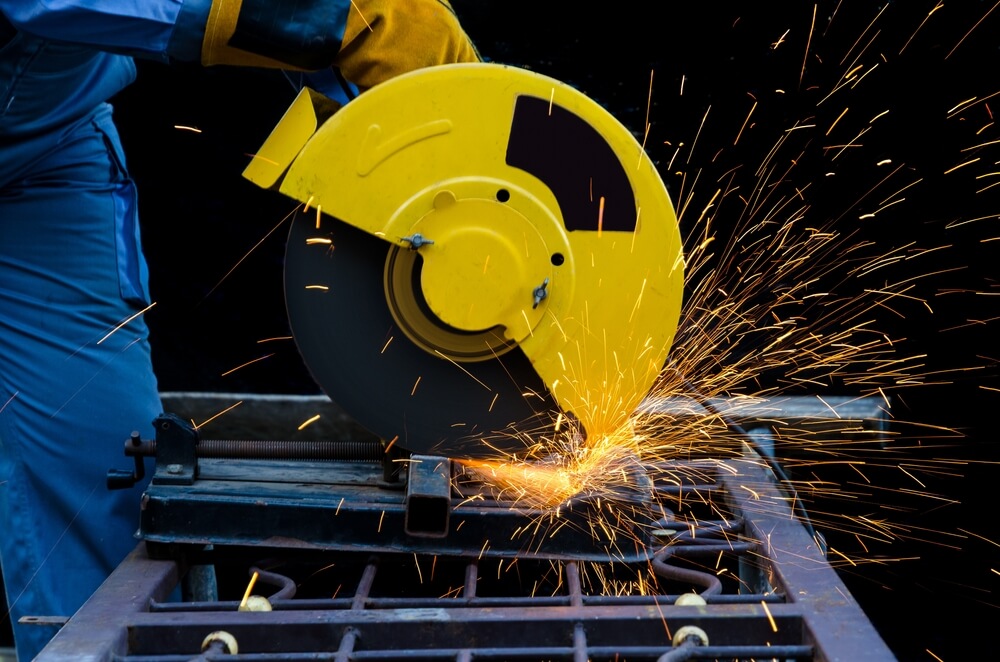
Effective machine guarding serves multiple protective functions simultaneously. It shields the operator from the point of operation, keeps bystanders safe from flying debris or sparks, and prevents loose clothing or hair from becoming entangled in rotating parts.
The primary hazards that necessitate robust guarding include:
- Point of operation (the area where the actual work is performed on the material).
- Power transmission apparatus (components like pulleys, belts, gears, and chains).
- Other moving parts (mechanisms involving reciprocating, rotating, or transverse motions).
- Areas prone to ejecting flying chips, sparks, or hazardous materials.
When Is Machine Guarding Required Under OSHA Standards?
Under OSHA standard 29 CFR 1910.212, machine guarding is required whenever the operation of a machine exposes an employee to potential injury. If a machine features rotating parts, flying chips, sparks, or nip points, the employer must install appropriate guards to eliminate the hazard completely.
The general duty of an employer is to provide a workplace free from recognized hazards that are causing or are likely to cause death or serious physical harm. Regarding industrial machinery, this means the requirement for guarding is near-universal for equipment with exposed moving components. The law does not allow employers to rely solely on worker training, brightly colored warning signs, or administrative procedures when a physical guard can be installed to mitigate the risk.
If you walk onto a manufacturing floor near Parkersburg or a metal fabrication shop off Interstate 79, any equipment capable of catching a sleeve or drawing in a hand must feature a physical barrier. The requirement applies strictly, regardless of the machine’s age. “Grandfathering” does not exist for life-threatening safety hazards; older equipment must be retrofitted with modern guards to meet current safety standards.
OSHA’s general requirements for all machines specify that the guarding method must be effective and appropriate for the specific hazard. It cannot be flimsy, poorly fitted, or easily bypassed by a worker rushing to meet a quota.
Specific situations that strictly require guarding include:
- When ingoing nip points are created by rotating parts, such as gears or rollers, turning inward.
- When the point of operation exposes the operator to cutting, shaping, boring, or forming actions.
- When there is a documented risk of materials or broken machine parts being thrown during operation.
- When power transmission components are located within seven feet of the floor or working platform.
What Types of Machinery Mandate Guarding in West Virginia Facilities?
Almost all industrial equipment with moving parts requires guarding, but OSHA specifically mandates protections for presses, power saws, shears, automated packaging machinery, and conveyor systems. Any equipment that cuts, bends, punches, or shapes materials must have physical barriers protecting the operator’s hands and body.
The industrial landscape of West Virginia utilizes a vast array of heavy machinery, much of which falls under strict federal scrutiny. In the chemical plants of the Kanawha Valley, massive pump systems and automated conveyors require substantial protective barriers to prevent entanglement. In the logging and timber operations of the state, large-scale cutting, milling, and debarking equipment must be rigorously shielded to protect workers from massive blades and flying debris.
A common misconception in the industry is that only large, stationary manufacturing equipment requires protection. However, the rules apply equally to smaller, mobile, or portable tools used on active construction sites or in smaller commercial fabrication shops. If a tool has an exposed blade, a pinch point, or a crushing mechanism, the law demands a protective barrier.
Certain categories of machinery are repeatedly involved in severe accident investigations due to inadequate guarding:
- Guillotine cutters and industrial shears are used in metal and paper fabrication
- Milling machines, industrial drill presses, and automated lathes
- Power presses, including mechanical, hydraulic, and pneumatic variants
- Circular saws, band saws, and other heavy-duty woodworking equipment
- Industrial mixers and blending equipment are used extensively in chemical processing
How Do I Know If a Machine Guard Is Legally Sufficient?
A legally sufficient machine guard must prevent any part of a worker’s body from contacting dangerous moving parts. Furthermore, it must be securely attached to the machinery, durable enough to withstand industrial use, and constructed so it does not create a new hazard itself.
Simply placing a piece of plastic or thin wire mesh near a moving part does not fulfill an employer’s legal obligation to protect their staff. OSHA outlines strict criteria for what constitutes an acceptable safety guard. The barrier must be a permanent part of the machine or rigidly secured to it using tamper-resistant hardware. If a worker can easily move, bypass, or remove the guard without specialized tools, it is likely non-compliant and legally insufficient.
In many serious workplace injury cases handled in venues like the Kanawha County Circuit Court, the central issue is not that a guard was completely missing, but that it was profoundly inadequate. A flimsy guard that bends under pressure, or a barrier that still allows a hand to reach the point of operation, provides a false sense of security. This false security can be deadlier than having no guard at all, as workers may interact with the machine, assuming they are protected.
An effective and legally compliant guard must meet these essential criteria:
- Prevent contact: It must be physically impossible for hands, arms, or any body part to reach the hazard zone.
- Remain secure: Guards should be robust and not easily removable, altered, or prone to tampering.
- Protect from falling objects: The design must prevent tools or materials from falling into moving parts and becoming projectiles.
- Create no new hazards: The guard itself cannot have sharp edges, shear points, or unpolished surfaces that could cause lacerations.
- Allow safe lubrication: Workers must be able to oil or maintain the machine without removing the primary safety guard.
What Are the Most Common Machine Guarding Violations in the Kanawha Valley?
The most frequent machine guarding violations involve employers intentionally removing guards to speed up production, failing to replace broken barriers, or bypassing electronic safety sensors like light curtains. Additionally, using makeshift, non-compliant materials to replace factory-issued safety components is a widespread and dangerous violation.
Despite clear federal regulations, machine guarding consistently ranks among OSHA’s top ten most frequently cited violations nationwide, and West Virginia is no exception. In facilities operating under tight deadlines or facing supply chain delays, there is often pressure from management to maintain continuous operation. This frequently manifests as a tolerance for unsafe conditions or direct instructions to tamper with safety equipment.
We often review incident reports where electronic interlock devices designed to immediately shut off the machine if an access door is opened are taped over, mechanically jammed, or hot-wired. This converts a relatively safe piece of equipment into a lethal hazard. When a worker is assigned to a machine that has been modified in this manner, they are being subjected to an unacceptable, illegal level of risk.
Common violations that consistently put local workers in jeopardy include:
- Removing the point-of-operation guard on mechanical power presses to clear jams faster.
- Failing to guard the lower exposed portion of blades on portable or stationary circular saws.
- Leaving chains, sprockets, and drive belts completely exposed on continuous conveyor systems.
- Ignoring the requirement to securely anchor fixed machinery to the floor, allowing the equipment to “walk” or shift dangerously during operation.
Who Is Liable When a Missing Machine Guard Causes Injury?
Liability for machine guard injuries typically involves the employer through the workers’ compensation system. However, in West Virginia, you may pursue a “deliberate intent” claim against the employer or a third-party product liability claim against the manufacturer if the machine was defectively designed.
Navigating the legal landscape after an industrial accident in West Virginia requires understanding the complex intersection of state and federal law. Ordinarily, the state’s workers’ compensation system provides coverage for medical bills and partial wage replacement regardless of who was at fault for the accident. However, this system often fails to cover the full spectrum of loss, especially for severe, life-altering injuries like amputations or crush injuries common in machine guarding cases.
West Virginia law includes a highly specific provision known as the “deliberate intent” statute. If your employer had actual knowledge that a machine guard was missing, bypassed, or fundamentally inadequate, understood that this created a high degree of risk for serious injury, and intentionally exposed you to that hazard anyway, you may have grounds to step outside the workers’ compensation system. In these specific circumstances, you can file a civil lawsuit directly against the employer in venues such as the Kanawha County Circuit Court or the Ohio County Circuit Court in Wheeling.
Furthermore, third-party liability is a critical avenue for financial recovery. If the machinery was manufactured and sold to your employer without adequate safety guards in place, the manufacturer might be held responsible for introducing a defective product into the stream of commerce.
Potential avenues for compensation and accountability include:
- Workers’ compensation claims are filed and managed through the Offices of the Insurance Commissioner.
- Deliberate intent lawsuits against an employer who knowingly and intentionally allowed unsafe conditions to persist.
- Third-party product liability claims against equipment manufacturers or industrial distributors.
- Negligence claims against outside maintenance contractors who serviced the equipment but failed to properly reinstall safety guards.
What Steps Should I Take If I Notice Missing Machine Guards at Work?
If you notice missing machine guards, immediately report the hazard to your supervisor in writing, request that the equipment be locked out until repaired, and document the condition with photographs if permitted. If the employer refuses to fix it, file a formal complaint with OSHA.
Witnessing unsafe working conditions places a heavy burden on employees, who are often caught between prioritizing their physical safety and maintaining their livelihood. You have a legally protected right to work in an environment free from recognized hazards. If a supervisor instructs you to operate a stamping press without a functioning light curtain or a saw without a securely attached blade guard, you are being asked to risk your physical well-being for their production quota.
Under the OSH Act, you have the right to refuse a work assignment if you have a reasonable, good-faith belief that the condition poses an immediate danger of death or serious physical injury, and there is insufficient time to report the hazard to OSHA for a standard inspection. If you are working at a facility near the Kanawha River or a site in the Marcellus Shale region, and a machine is clearly unsafe, you must take steps to protect yourself.
To effectively document and report a machine guarding hazard:
- Notify management via email or text message to create a permanent, timestamped record of your concern.
- Note specific details about the failure, such as “the interlock switch on the primary mixing vat has been bypassed.”
- Identify and list witnesses who can confirm the equipment was operated without a guard or in an unsafe condition.
- If the issue remains unresolved, contact the OSHA Charleston Area Office on Capitol Street or the Wheeling Area Office, depending on your geographic location.
Protecting Your Rights After an Industrial Accident
Navigating the aftermath of a severe workplace accident involves complex federal regulations, state statutes, and aggressive insurance adjustments. If you or a loved one has been affected by unsafe working conditions or an employer’s failure to follow OSHA machine guarding regulations, you deserve clear answers and dedicated support. Please contact OSHA Injury Attorney to share the details of your situation.
 What Rights Do Workers Have When They Witness Unsafe Working Conditions?
Leave a Reply
Want to join the discussion?Feel free to contribute!